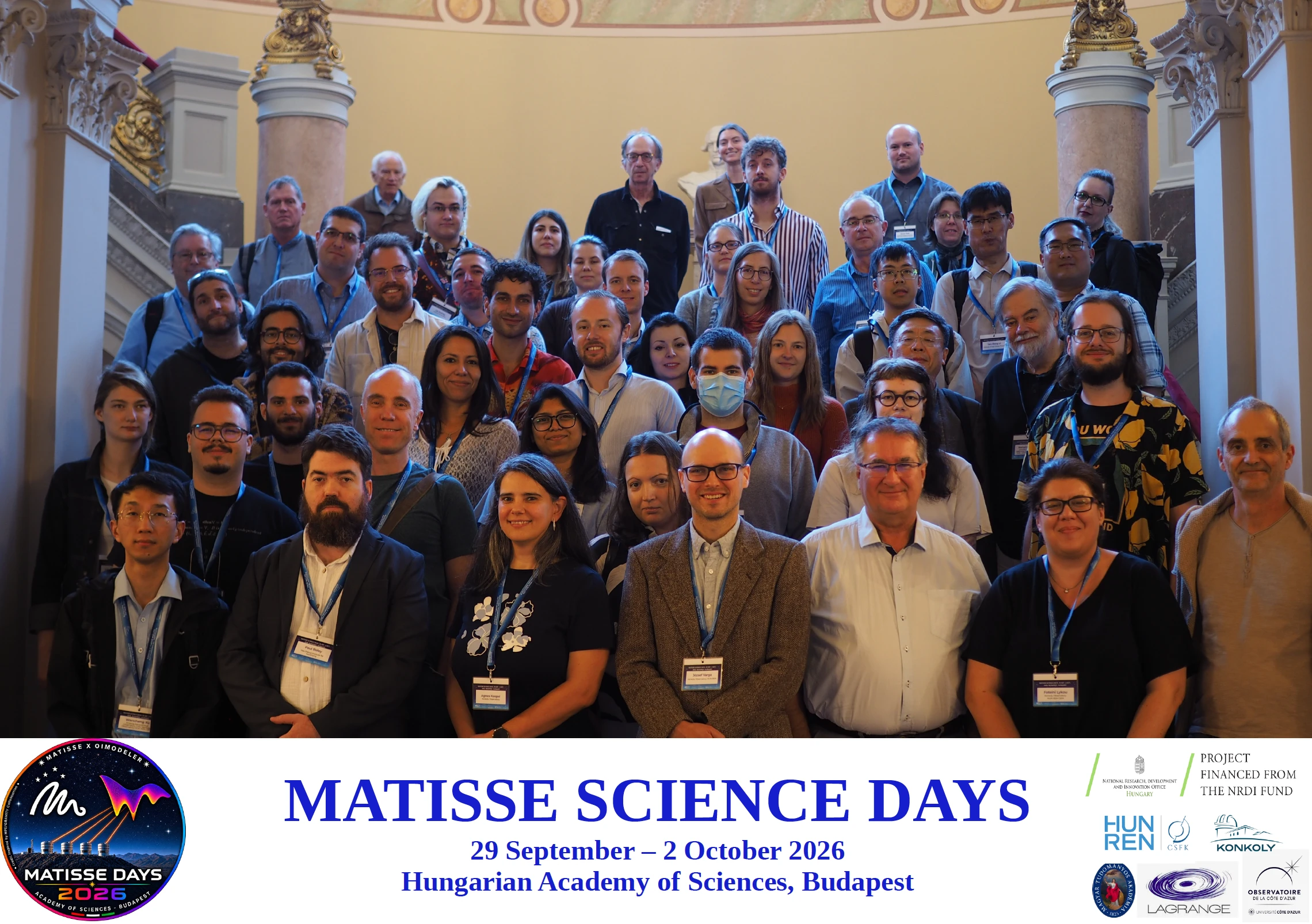
The second MATISSE Science Days concluded last week at the headquarters of the Hungarian Academy of Sciences in downtown Budapest, gathering a hundred registered participants — two thirds of them in person and one third online — from 18 countries across four days of scientific talks, discussions, and hands-on sessions. The workshop was organized and hosted by the VLTI Expertise Centre of Konkoly Observatory of the HUN-REN Research Centre for Astronomy and Earth Sciences.
MATISSE (Multi AperTure mid-Infrared SpectroScopic Experiment) is the mid-infrared beam combiner instrument at ESO’s Very Large Telescope Interferometer (VLTI) at the Paranal Observatory in Chile. With an angular resolution of a few milliarcseconds, equivalent to reading a newspaper from 100 kilometres away, MATISSE provides unique views of the innermost regions of planet-forming disks, the dusty cores of active galaxies, the surfaces of giant stars, and the atmospheres of giant exoplanets.
A Community Review of Frontier Science
Following the first successful MATISSE Science Meeting held in Nice, France in 2024, the Budapest edition brought together observers, modellers, and instrument specialists to review the latest results from the instrument and chart the path ahead. The four-day scientific program, spread across six thematic blocks, covered the full breadth of MATISSE science:
- Young stellar objects and planet-forming disks: new VLTI/MATISSE observations of T Tauri stars and Herbig Ae/Be objects revealed structures in the innermost regions of protoplanetary disks at scales inaccessible to any other current facility. Combined analyses with JWST/MIRI data opened new windows on disk chemistry and dust physics.
- Active galactic nuclei: talks presented the latest interferometric maps of the dusty tori around supermassive black holes, including constraints on tidally disrupted gas inflows, broad-line region geometries, and the first comparative results from MATISSE’s new AGN sample.
- Evolved stars: multi-wavelength interferometric imaging campaigns with VLTI/MATISSE, CHARA, and ALMA probed the extended atmospheres and circumstellar environments of cool giant and supergiant stars.
- Giant planet atmospheres: first results from mid-infrared planet spectroscopy with MATISSE were presented, including the characterisation of a directly imaged brown dwarf and prospects with next-generation facilities.
- New avenues and synergies: one session addressed time-domain interferometry, nulling interferometry with ASGARD/NOTT, and the scientific potential of proposed future instruments and missions including VLTI/SHARPS, ELT/METIS, Carbon4Life, Kiloscope, and THESEUS.
A public lecture by the Principal Investigator of MATISSE, Bruno Lopez (Observatoire de la Côte d’Azur), on “Excursion to the birthplace of Earth-like planets” was open to a wider audience on the evening of 1 October.
First Interferometric Modelling Challenge
A highlight of the meeting was a dedicated hands-on session for Oimodeler, an open-source Python package for modelling optical interferometric data from VLTI and other facilities. The session was led by its developers, Anthony Meilland and Valentin Fleury (Observatoire de la Côte d’Azur), and introduced the new Oimodeler App, an interactive, no-code interface making interferometric model fitting accessible to a broader community.
Alongside the hands-on session, participants took part in the Oimodeler Sprint Week, the first-ever interferometric modelling challenge, designed to benchmark analysis techniques and foster best practices across the community.
The participants also visited Konkoly Observatory and were given a guided tour of the exhibition entitled “200 Years of Treasures” at the Hungarian Academy of Sciences.
Contact:
Péter Ábrahám
Konkoly VLTI Expertise Centre, Konkoly Observatory
public.btn.email
Foteini Lykou
Konkoly VLTI Expertise Centre, Konkoly Observatory
public.btn.email
Bruno Lopez
Observatoire de la Côte d’Azur
public.btn.email
Website: https://vlti-ec.konkoly.hu/matisse2026/
This event was supported by the MEC_SZ 156384 grant, which have been implemented with the support provided by the Ministry of Culture and Innovation of Hungary from the National Research, Development and Innovation Fund, financed under the MEC_26 funding scheme.
.jpg)