Using the powerful ALMA antenna array in Chile, researchers were able to “see” inside the disk, nicknamed the “Flying Saucer” due to its unique edge-on view from Earth.
Located 390 light-years away in the Ophiuchus constellation, the Flying Saucer disk offers an unprecedented opportunity to study the conditions where planets arise. The team mapped over a dozen molecules – essential building blocks for life, formed from hydrogen, carbon, sulfur, nitrogen, and oxygen – and determined their altitude (height) and radial distribution within the disk.
The observations revealed a complex structure, with temperatures plummeting to -253°C (-423°F). Researchers discovered where molecules are freezing and forming icy coatings on dust grains, marking the potential birthplaces of planetary embryos. They also found evidence supporting current theories about how certain molecules, like those containing “heavy hydrogen,” concentrate in specific layers close to the deepest interior of the disk.
“This is a major step forward in understanding how planetary systems form around stars like our Sun,” said Ágnes Kóspál, research advisor at Konkoly Observatory of the HUN-REN Research Centre for Astronomy and Earth Sciences. “By mapping these molecular layers, we’re getting a glimpse of the chemical ingredients and physical conditions necessary for creating new planets.”
The findings will help refine models of planet formation and provide valuable insights into the origins of planets, including our own.
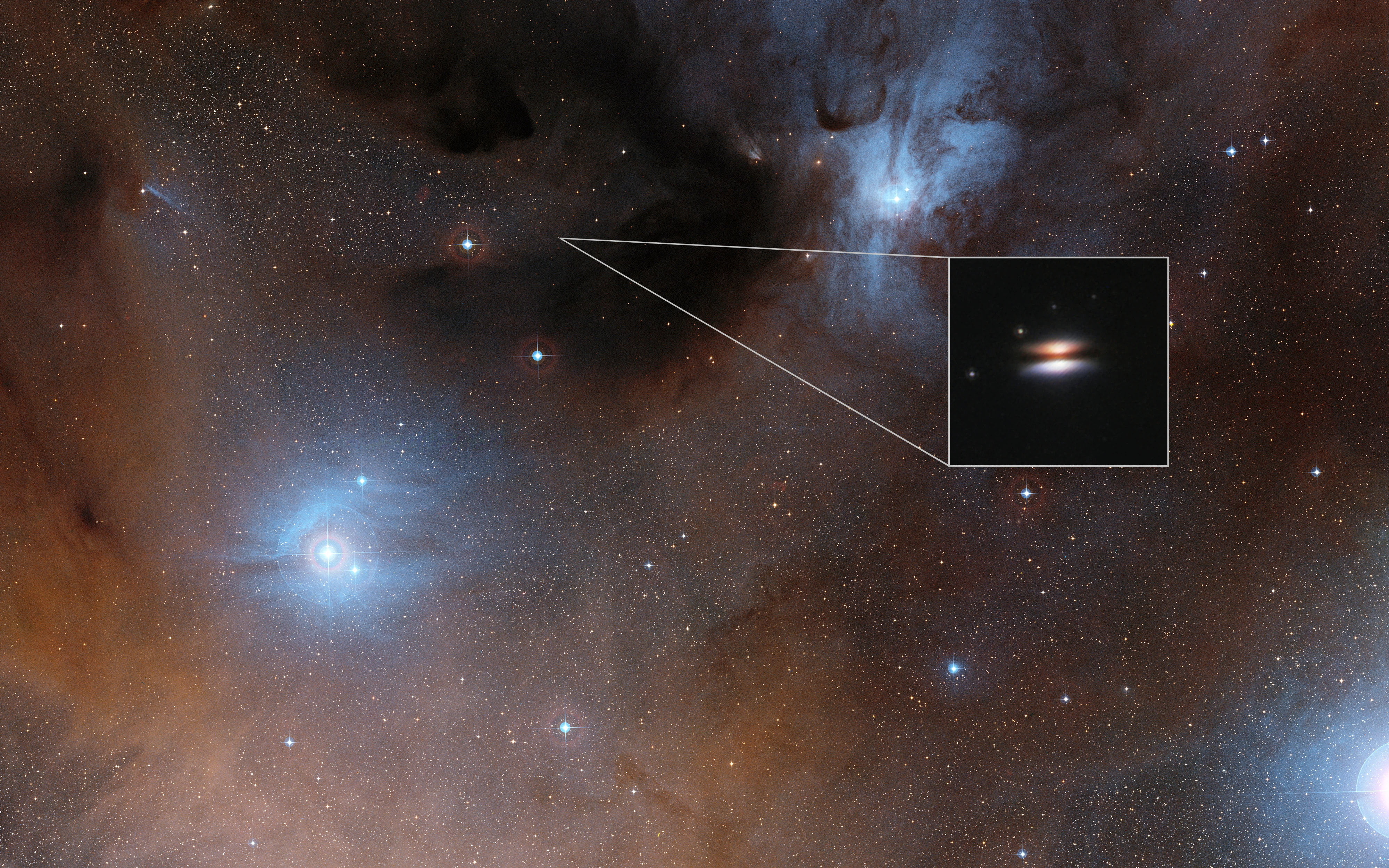
Figure 1: Location of the Flying Saucer planet-forming disk within the Ophiuchus star-forming region. Source: ESO/NASA/ESA
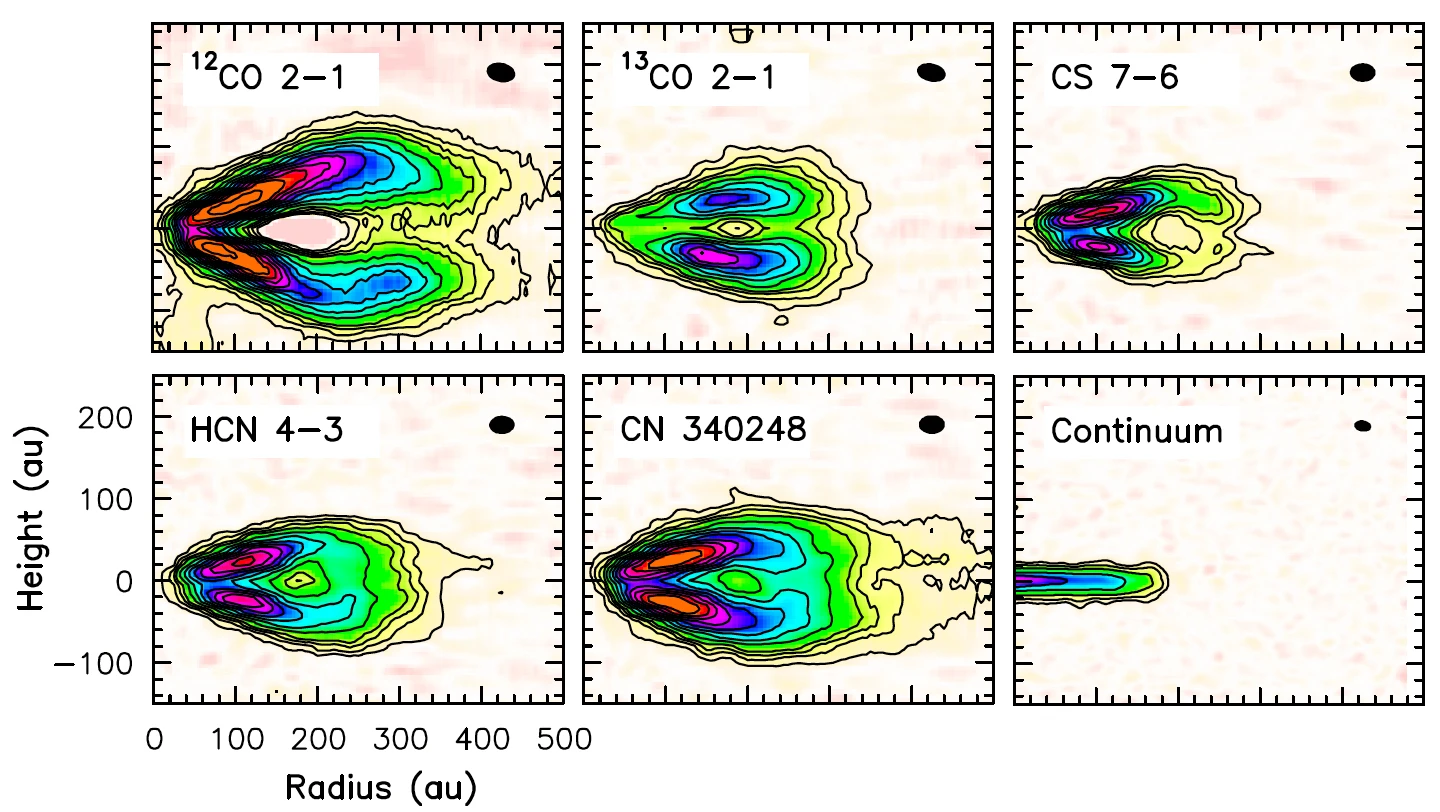
Figure 2: Spatial distribution of the emission of various molecules observed with ALMA in the Flying Saucer planet-forming disk. Magenta and orange colors indicate dense molecular layers, while green and yellow show where most molecules are frozen. Source: Dutrey et al. (2025)
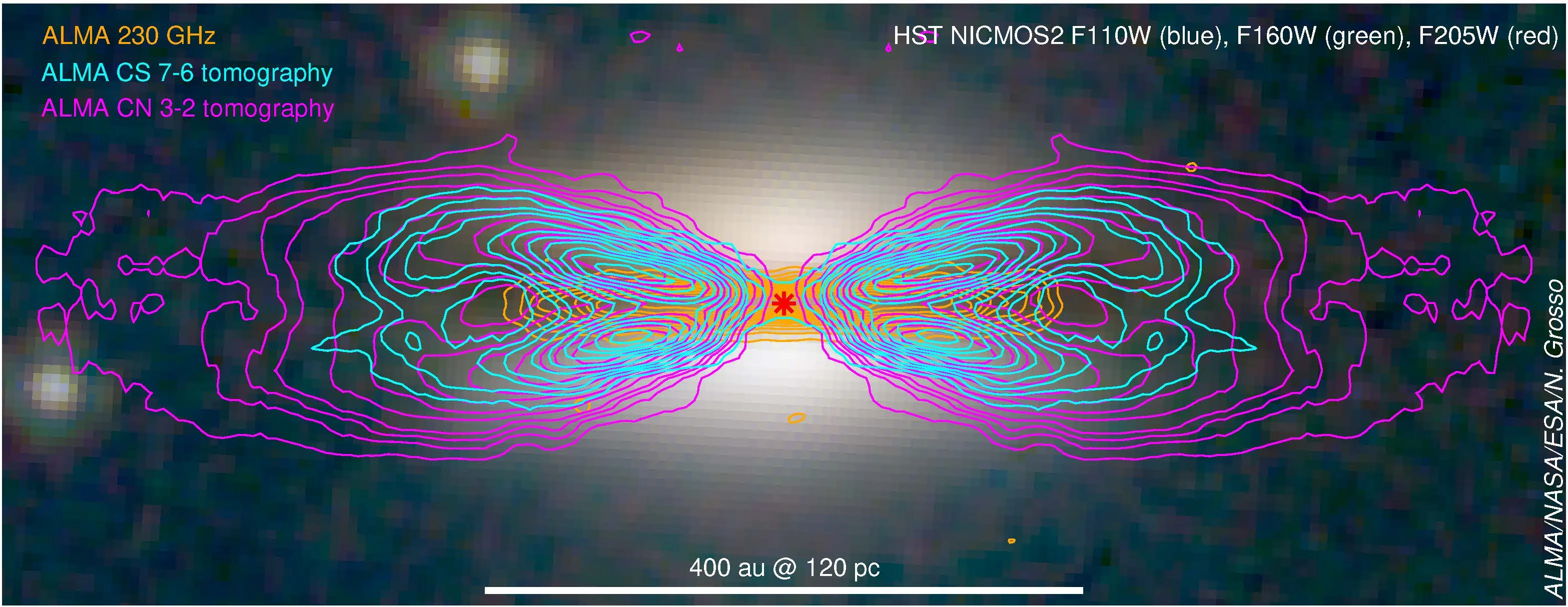
Figure 3: Emission from the CS and CN molecules detected by ALMA is shown with cyan and magenta contours. In orange, millimeter-wave radio emission from dust particles is indicated. The background image is from the Hubble Space Telescope and displays near-infrared light scattered by small dust particles. Source: ALMA / HST / N. Grosso – Dutrey et al. (2025), Guilloteau et al. (2025)
More information:
Guilloteau et al. (2025): Edge-On Disk Study (EODS): I. Thermal structure of the Flying Saucer disk. Astronomy & Astrophysics, https://www.aanda.org/10.1051/0004-6361/202554853
Foucher et al. (2025): Edge-On Disk Study (EODS) II: HCO+ and CO vertical stratification in the disk surrounding SSTTau042021, Astronomy & Astrophysics, https://www.aanda.org/10.1051/0004-6361/202554807
Dutrey et al. (2025): Edge-On Disk Study (EODS) III: Molecular Stratification in the Flying Saucer Disk. Astronomy & Astrophysics, https://www.aanda.org/10.1051/0004-6361/202555641
Contact
Ágnes Kóspál
Konkoly Observatory, HUN-REN Research Centre for Astronomy and Earth Sciences
public.btn.email