The Euclid Consortium and the European Space Agency1 today release DR1 Foundation, the first part of the mission’s first major data release (DR1). Covering 1,900 square degrees of the sky, equivalent to around 14% of the sky area planned for the 6-year mission, this unprecedented collection of optical and near-infrared observations represents the largest map of the sky of its kind ever produced from space. This data combines exceptionally sharp images, extensive catalogues, and millions of spectra, offering the international astrophysics community an unprecedented wealth of data to explore a wide range of astrophysical questions and drive new discoveries.
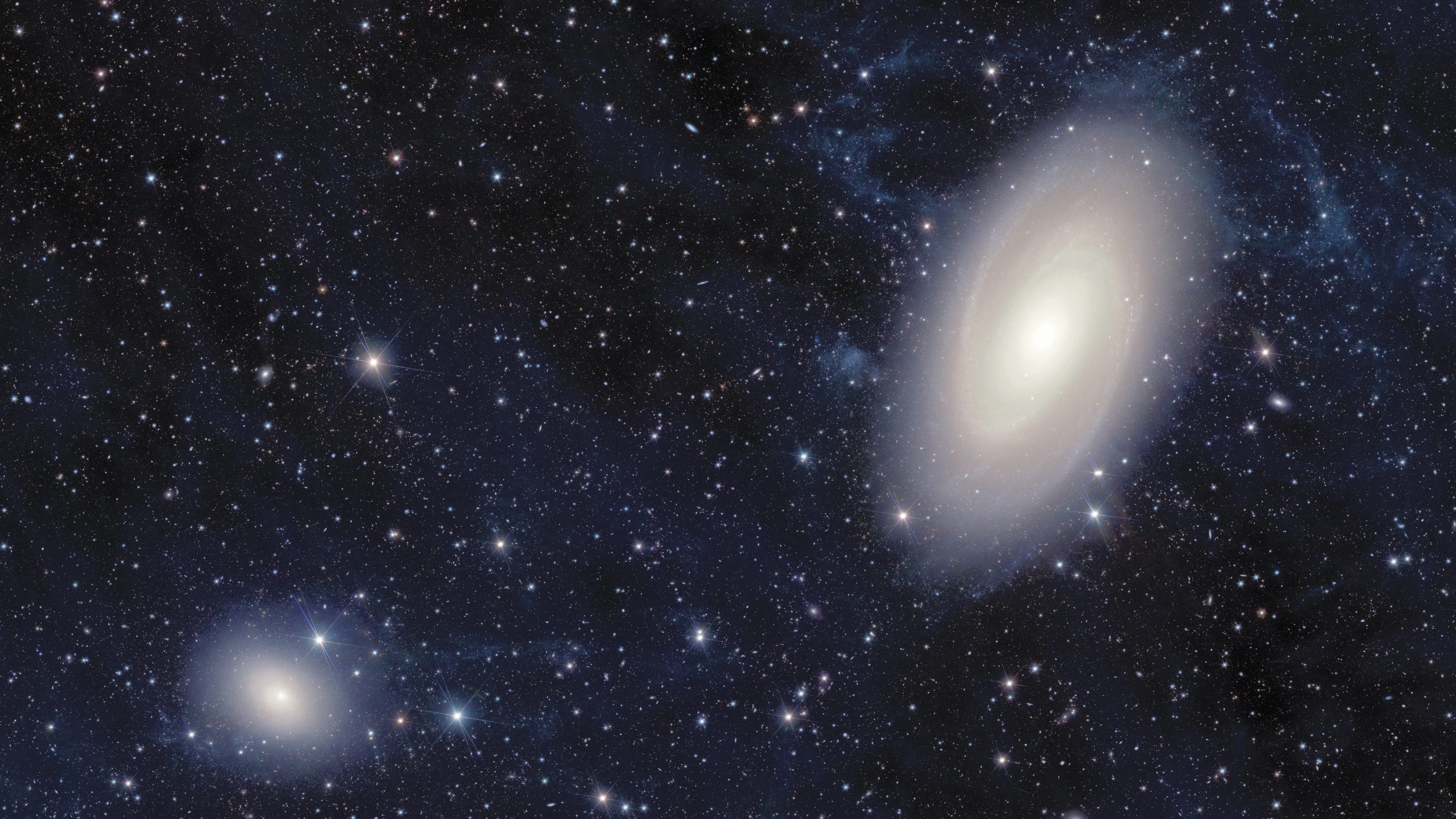
DR1 Foundation contains approximately 10,000 science images obtained by Euclid’s two instruments, VIS and NISP, and catalogues describing the celestial objects detected in these 1 Read ESA’s story here (incoming link) observations. In just over one year, Euclid catalogued more than 900 million galaxies across the released area. In addition, several regions were observed repeatedly over extended periods, known as the Euclid Deep Fields, allowing astronomers to probe galaxies dating back up to 10 billion years. The release also includes more than 160 million spectra, providing crucial and complementary information about the observed objects. “This is only 14% of what Euclid ultimately intends to deliver, but we can already see that the promises made more than ten years ago about the span of scientific endeavours Euclid would support are starting to come true.” says Marc Sauvage, astrophysicist at CEA's Institute for Research on the Fundamental laws of the Universe (Irfu) and Euclid Consortium lead. Spectroscopy Euclid’s Near-Infrared Spectrometer and Photometer (NISP) uses slitless spectroscopy, dispersing the near-infrared light (930 to 1890 nm) from thousands of celestial objects simultaneously across its detectors. This technique, combined with Euclid’s wide field of view, enables an unprecedented number of spectra to be captured in a single image, without requiring individual slits or targeted observations.
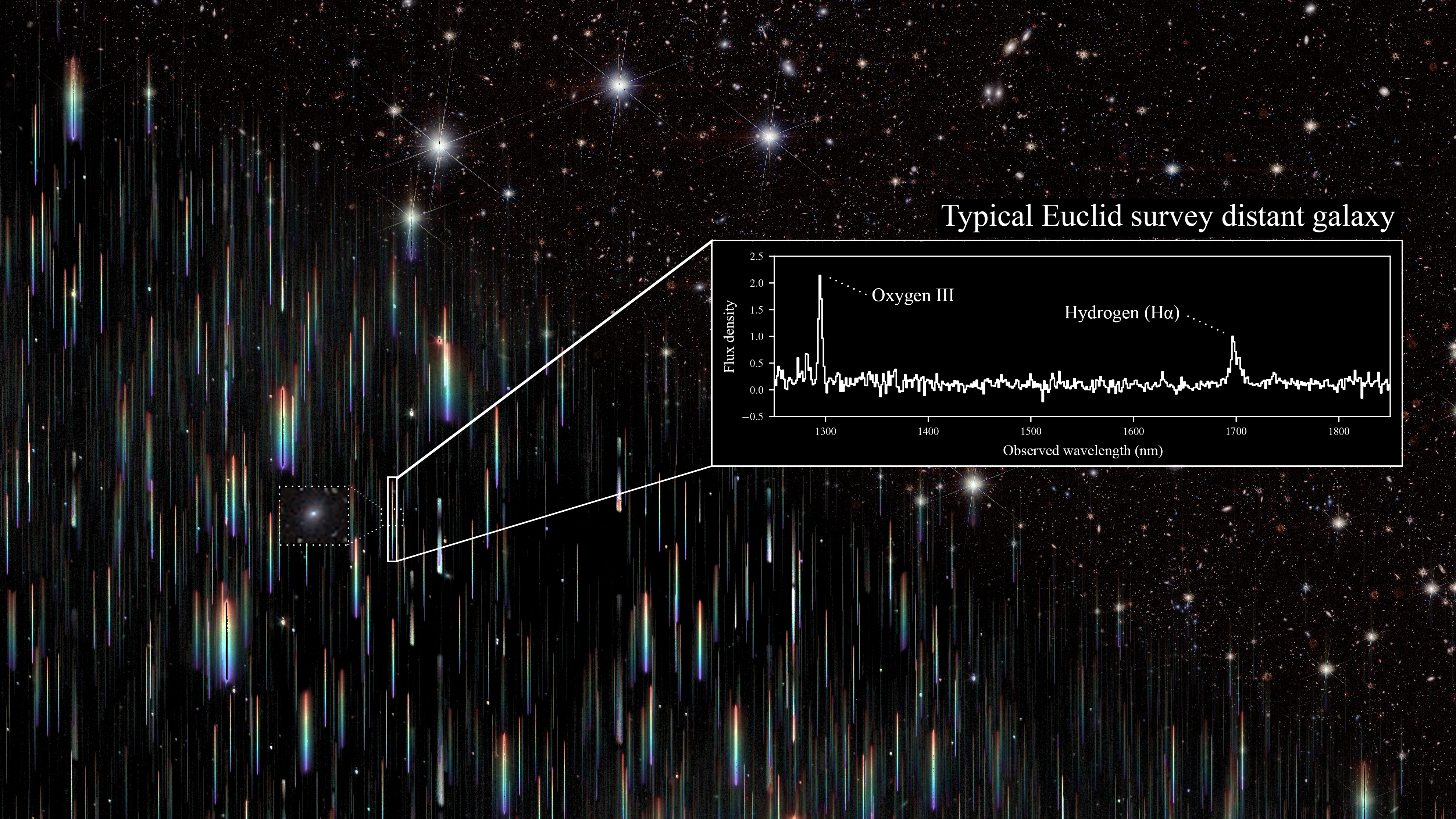
A unique image of NISP is here shown with its two aspects: the spectrum of each object in the lower left part of the image, and their image in the upper right part. A part of the near-infrared colors of the spectra has been shifted to visible for visualization. Image credit: ESA/Euclid/Euclid Consortium/NASA, image processing by the Euclid science ground segment and Benjamin Granett.
Each spectrum reveals characteristic emission and absorption features, allowing astronomers to measure redshifts, estimate distances and investigate the chemical composition and physical conditions of galaxies. “This first data release already provides millions of extragalactic spectra, changing the way we do science. I started my career studying tens of galaxies in great detail, whereas now, with Euclid, I am combining observations of thousands of galaxies with similar masses to investigate their common properties.” states Chiara Mancini, astrophysicist at INAF, the Italian National Institute for Astrophysics. Combined with Euclid’s high-resolution imaging, these 160 million spectra will help scientists study star formation, galaxy evolution, internal dynamics and the interactions between stars, gas and supermassive black holes.
Scientific results Following the data release on 12th November 2026, 26 scientific papers were published on Arxiv, including 8 analysis papers.
Four papers present major results on strong gravitational lensing, a phenomenon in which massive galaxies distort and magnify the light of more distant objects. Euclid Consortium researchers identified more than 15,000 lens candidates, creating the largest homogeneous catalogue of its kind to date. Artificial intelligence, citizen science and expert validation were combined to identify these systems among the 900 million galaxies detected in the DR1 Foundation data. The discoveries include rare configurations involving multiple background sources, disc galaxies and lensed quasars.
Automated modelling and characterisation were also successfully applied to thousands of candidates, enabling researchers to estimate galaxy masses and reconstruct distant galaxies that would otherwise be difficult to observe, and provide insights into their properties and evolution. “This is a true pivotal moment for strong lensing science, one that we have been waiting for almost 50 years since the first strongly lensed system was observationally discovered. “ explains Aprajita Verma, Associate Professor at the University of
Oxford. Complementary studies demonstrate Euclid’s powerful spectroscopic capabilities, using emission-line maps to confirm lensed-galaxy structures and obtain spatially resolved measurements of star formation and galaxy kinematics, providing new insights into galaxy evolution. In its six years of observations, Euclid is expected to discover more than 100,000 such systems, significantly expanding the statistical power of studies of galaxy formation and evolution, dark matter and cosmology.
In addition, 15 very-low-surface-brightness stellar systems have been resolved into stars for the first time, including 5 discoveries and Milky way satellites candidates. Lastly, a study on 40 million galaxies shows that “puffy”, three-dimensional galaxies become rarer as the Universe ages: over cosmic times, many of them gradually settle into flat, orderly rotating discs. DR1 Foundation data will serve as the base for the full DR1 release that will deliver the mission’s first cosmological analyses. Alongside to the results presented above, it already enables researchers to investigate a broad range of astrophysical questions beyond cosmology, from galaxy clusters, the cosmic web, dwarf galaxies, quasars and active galactic nuclei, to transient phenomena2. A glimpse of these remarkable capabilities was already revealed a few months ago, when these data led to the discovery of the two most distant quasars known to date, which would have been missed by smaller surveys3.
Processing of the Euclid observations
While the scientific results presented above are unprecedented and highly promising for the future of the mission, they represent only the visible part of the considerable ongoing work being carried out by the Euclid Consortium. Producing such high-quality data requires an extensive processing effort. Once captured by the telescope, raw images undergo rigorous treatment by the engineers and researchers of the Euclid science ground segment (SGS), who work daily to orchestrate the automated processing algorithms, monitor the progress, make quality assessments, fix problems and develop new algorithms to improve the Euclid data processing.
These pipelines correct the images from Euclid’s two instruments, the optical camera VIS and the near-infrared instrument NISP, for a wide range of instrumental and systematic effects. They then detect tens of millions of sources and extract their spectra, measure their positions and brightnesses with high precision, and, combined with ground-based observations at other
wavelengths, derive dozens of physical properties for each source. Every step is held to Euclid’s strict quality standards, which precision science demands. The full processing chain is described in the 18 technical papers published today.
The Euclid Consortium
The Euclid Consortium, in partnership with the European Space Agency (ESA) and the National Aeronautics and Space Administration (NASA), has designed and built the instruments of the Euclid space telescope. It has also developed and currently operates the science data pipeline, the system responsible for processing and organizing data from the telescope. This mission aims to map the extragalactic sky over a period of six years, providing unique data that offer new insights into dark energy and dark matter. Launched on July 1st, 2023, the telescope successfully began its cosmological survey on February 14th, 2024. The Euclid Consortium comprises more than 2000 members, from more than 300 laboratories in
15 European countries, plus Canada, Japan, and the United States, covering various fields in astrophysics, cosmology, theoretical physics, and particle physics.
The Euclid Consortium warmly thanks Ben Granett, Vincent Le Brun, Natalie Lines, Tian Li, Antoine Basset, Jean-Charles Cuillandre and Emmanuel Bertin for their precious work on the
public material used to communicate on this release.