The results come from the first stellar occultation specifically planned for and successfully observed with the James Webb Space Telescope (JWST).
Until just over a decade ago, ring systems were thought to be exclusive to the giant planets of the Solar System, such as Jupiter, Saturn, Uranus, and Neptune. However, in 2013, a small body barely 250 kilometers in diameter, located at nearly 17 times the Earth-Sun distance, joined this small group. The object is Chariklo, a small body orbiting between Saturn and Uranus, around which astronomers discovered two dense rings.
On October 18, 2022, the Institute of Astrophysics of Andalusia (IAA-CSIC) led an observation with the James Webb Space Telescope (JWST) to study Chariklo’s rings through a stellar occultation, a technique that measures the decrease in a star's light when an object passes in front of it. Now, a new study published in Science Advances and also led by the IAA-CSIC demonstrates, for the first time, that Chariklo’s ring system has undergone changes on timescales of just a few years.
“By comparing JWST observations with those obtained during other stellar occultations over the last decade, we discovered opposite changes in the two rings: while the inner ring shows significantly higher opacity, the outer ring shows lower opacity, ” explains Pablo Santos-Sanz, an IAA-CSIC researcher who leads the study.
This unexpected behavior indicates that Chariklo’s ring system is dynamic and may be subject to more complex physical processes than previously thought.
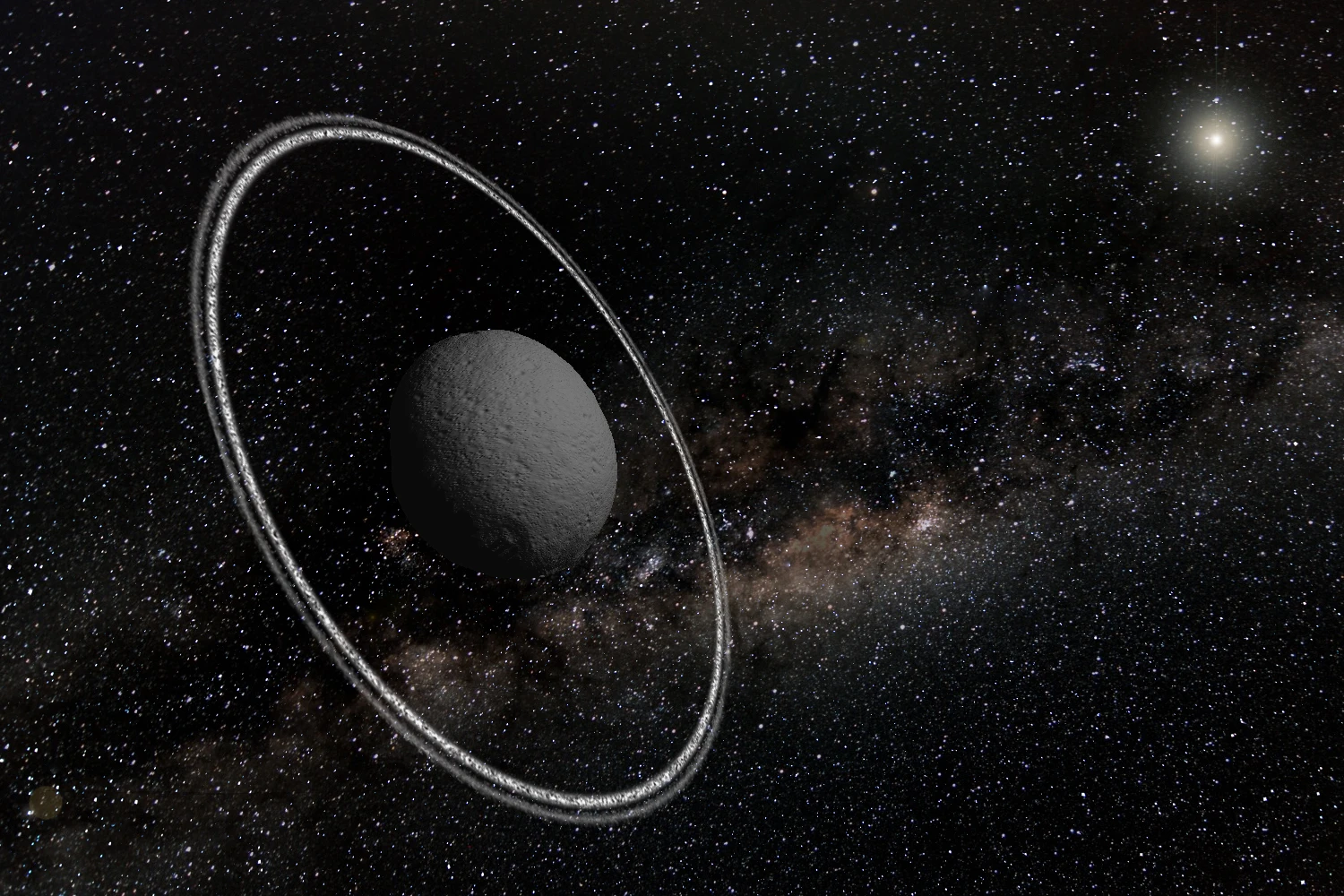
Artistic view of the centaur Chariklo and its ring system. The bright point in the upper-right corner represents the Sun as seen from Chariklo’s distance. Credit: L. Maquet, Observatoire de Paris.
A SCIENTIFIC AND TECHNOLOGICAL MILESTONE
The study also represents a significant technological advance: the occultation by Chariklo was the first stellar occultation specifically predicted and planned for observation with JWST and successfully observed from the space telescope.
“Achieving this required knowing with extraordinary precision the orbit of Chariklo, the position of the star—thanks to ESA’s Gaia mission—and the trajectory of JWST itself around the L2 Lagrange point, a region of space located about 1.5 million kilometers beyond Earth, away from the Sun. JWST follows an orbit around this region that requires periodic corrections through station-keeping maneuvers,” notes Yücel Kilic, postdoctoral researcher at the IAA-CSIC and co-author of the study.
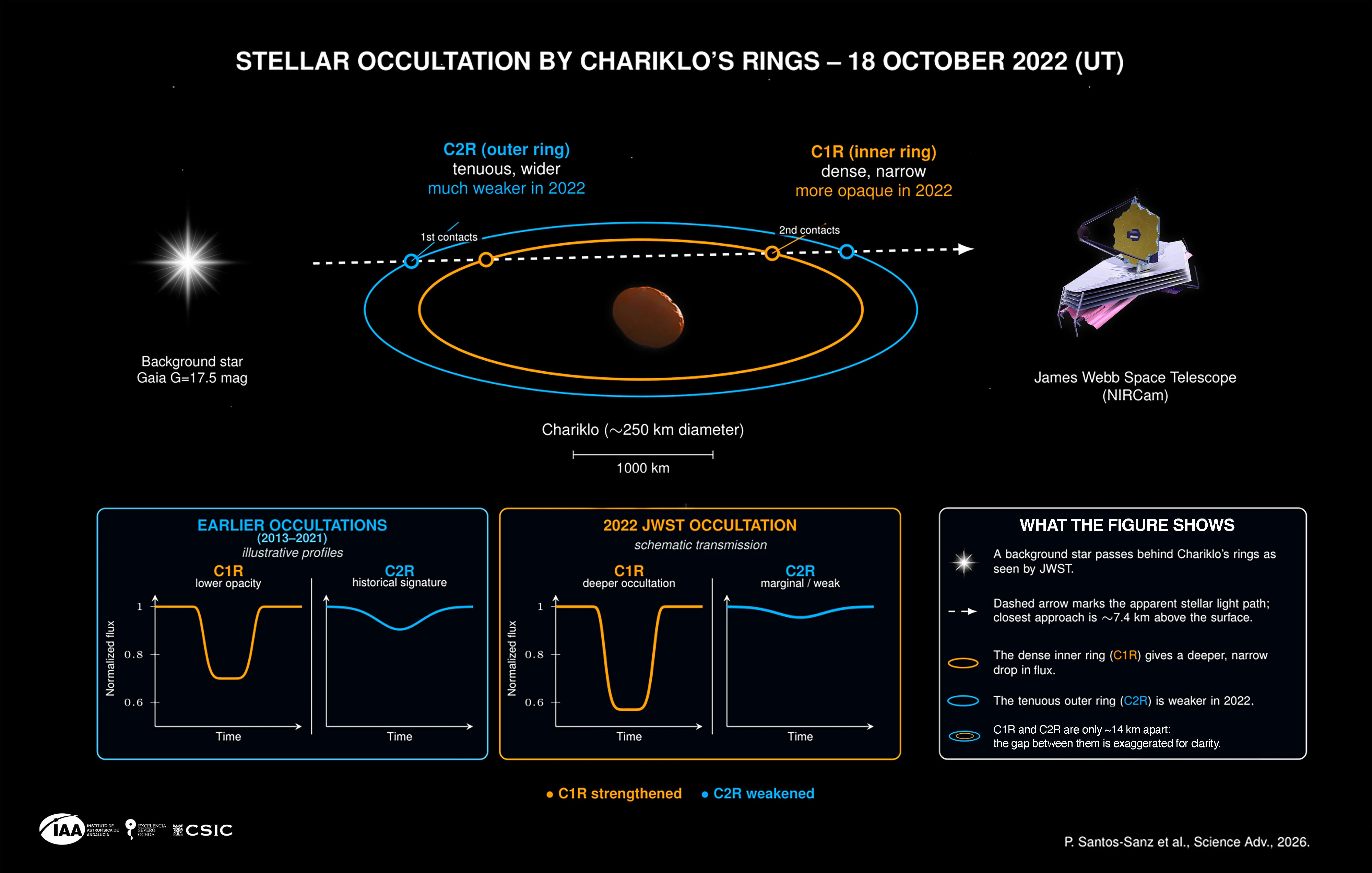
Schematic representation of the stellar occultation by Chariklo’s rings observed with the James Webb Space Telescope (JWST) on 18 October 2022. Comparison with previous occultations reveals opposite changes in the two rings: C1R shows a stronger signal, while C2R appears much weaker. Credit: Yücel Kılıç, Pablo Santos-Sanz and Celia Navas (IAA-CSIC)
At the time of the occultation, Chariklo was moving relative to JWST at just 2.5 kilometers per second. This exceptionally low relative speed provided unprecedented spatial resolution for studying the structure of its rings. These rings are so narrow, and Chariklo is so far away, that they cannot be photographed directly, even with the James Webb Space Telescope or the largest ground-based telescopes. Stellar occultations allow astronomers to study them indirectly by measuring brief dips in a star's brightness as each ring passes in front of it.
Until now, scientists considered the rings around small bodies in the Solar System relatively stable. The changes detected in Chariklo challenge this view and suggest that these systems may be much more dynamic than previously thought. “Our results force us to rethink how they form, how they evolve, and what mechanisms maintain their stability. The ability to detect these changes opens a new window for understanding the evolution of these systems and, possibly, that of other ring systems in the Solar System,” says Santos-Sanz. The physical origin of the detected changes, however, remains an open question: they could reflect temporal evolution of the rings, differences related to the use of different filters, or a combination of both effects.
This work was carried out in collaboration with researchers from Spain, Brazil, France, Hungary, and the United States. Csilla Kalup and Csaba Kiss, co-authors of the study and researchers at HUN-REN CSFK, analysed the decrease in the star’s brightness caused by the ring and modelled the physical processes behind it. Their contribution aimed to establish a connection between the observations and the possible composition and physical properties of the particles making up the rings. Based on these analyses, the inner ring, which shows a higher opacity, may consist of a mixture of silicate and water-ice particles a few micrometres in size. The increasing opacity of the ring may also indicate that collisions within the ring produce significant amounts of dust by fragmenting its larger components.
Because Chariklo passes through a dense stellar field as seen from Earth, further stellar occultations are expected in the near future. These observations will provide additional information about how the rings change on timescales of just a few years.
REFERENCES
‘JWST stellar occultation reveals unexpected changes in Chariklo’s ring system’

Animated GIF of the occultation by Chariklo, captured by the JWST. Credit: NASA, ESA, CSA, Pablo Santos-Sanz and Nicolás Morales (IAA-CSIC).