The object, TGSS J1530+1049, is so far away that the light and radio emission from it traveled for more than 12 billion years before reaching Earth. The radio galaxy studied existed at a time when the Universe was just over 1.5 billion years old, about one-tenth of its current age. For researchers, these extremely distant objects are crucial because they help us understand how galaxy clusters and the very first giant galaxies began to form at the dawn of the Universe.
Collaboration between radio telescopes and the James Webb Space Telescope
Astronomers used the European VLBI Network (EVN), one of the world’s most sensitive radio interferometers, and the e-MERLIN radio telescope system in the UK to observe the galaxy’s radio emission with extremely high angular resolution. With these tools, the researchers mapped the shape and location of radio-emitting structures – extended lobes and compact hot spots – associated with the active galactic nucleus at the galaxy’s center. The radio astronomer group was led by Krisztina Éva Gabányi (Department of Astronomy at ELTE Eötvös Loránd University, HUN-REN–ELTE Extragalactic Astrophysics Research Group, and HUN-REN Research Centre for Astronomy and Earth Sciences). The results were compared with the observations made in the infrared range by the James Webb Space Telescope (JWST), which mapped the ionized gas in the galaxy’s surroundings. The two sets of measurements provide a unified picture of the rapid evolution of a young active galactic nucleus and its complex cosmic environment.
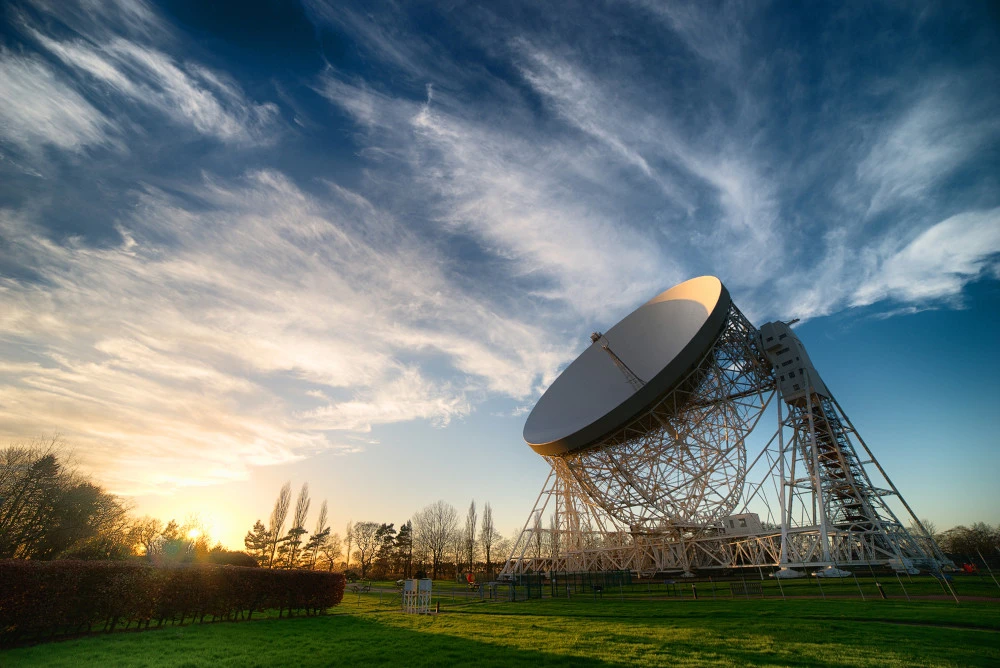
Fig. 1. The most sensitive antenna of the British e-MERLIN, the 76-m Lovell Radio Telescope in Jodrell Bank. (Credit: University of Manchester / Anthony Holloway)
https://www.manchester.ac.uk/about/news/asset/733417/lovelltelescope-anthonyholloway-695535
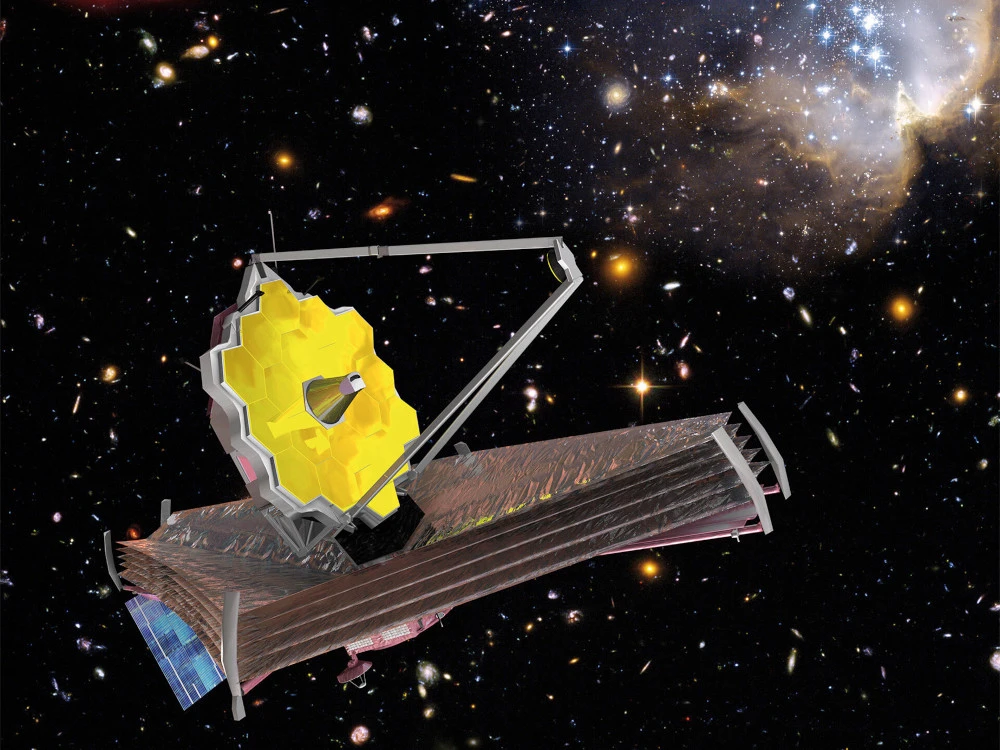
Fig. 2. Artist’s impression of the James Webb Space Telescope launched in 2021 with a 6.5-m diameter mirror. (Credit: ESA)
https://www.esa.int/var/esa/storage/images/esa_multimedia/images/2016/09/artist_representation_of_the_jwst/16155321-1-eng-GB/Artist_representation_of_the_JWST.jpg
On the trail of a “young” radio galaxy
High-resolution radio images show that TGSS J1530+1049 has a relatively small radio structure – about 17,000 light-years in diameter –, suggesting that the galaxy’s active nucleus is still young in cosmic terms. Researchers classify it among the so-called medium-sized symmetric objects, which can be considered precursors to radio galaxies that will later grow to enormous sizes.
Interestingly, the radio-emitting region and the gas distribution observed by the JWST show a nearly identical configuration, elongated in the north–south direction, but the latter is much larger, spanning nearly 75,000 light years. The environment of the young radio galaxy presents an extremely complex and dynamic picture. The detected gas motions suggest that the outflows of material (radio jets) emanating from the black hole are in direct interaction with the surrounding gas clouds.
In addition, several massive galaxies are crowded together here, within a region spanning just a few tens of thousands of light years. These galaxies are undergoing intense star formation and are expected to merge completely over the next few billion years.
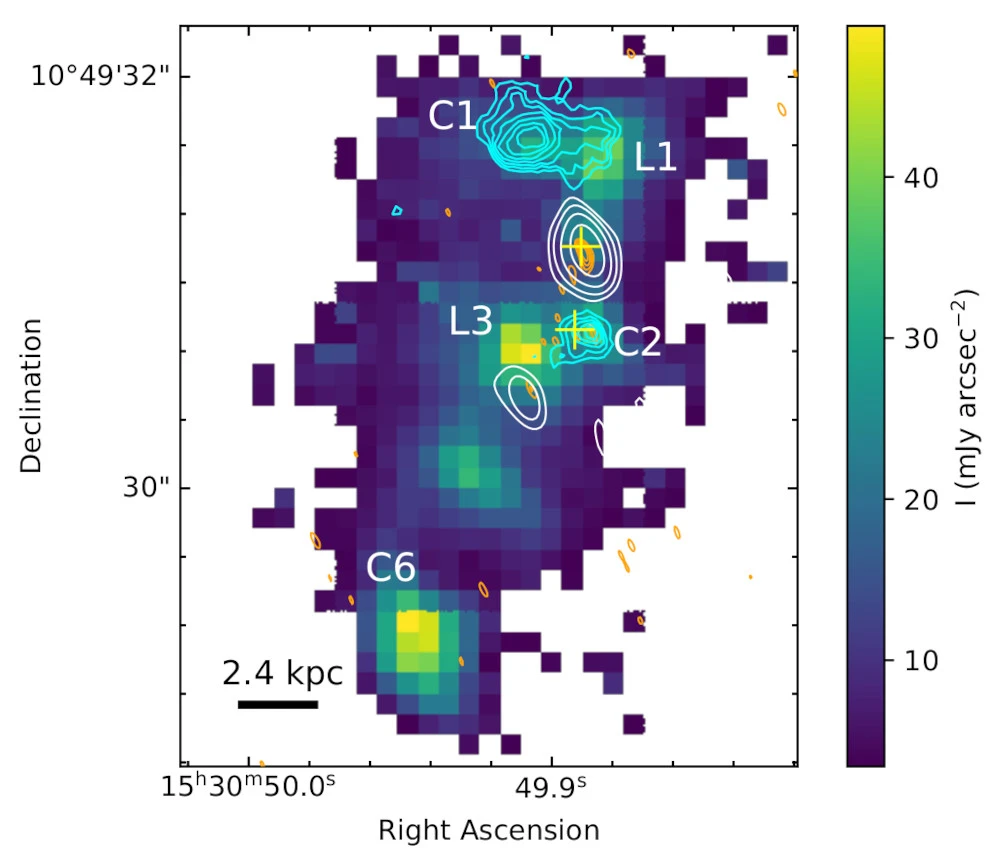
Fig. 3. The radio galaxy TGSSJ1530+1049 and its environment. White and orange contours show the 1.5- and 5-GHz radio intensity, respectively. The colour scale presents the distribution of the ionized hydrogen. Cyan contours show the infrared emission. The positions of the compact radio features, and optical and infrared emitting regions identified by Saxena et al. (2026) are indicated by yellow crosses and labels, respectively. The linear scale displayed in the lower left corner corresponds to approximately 7200 light years. (Credit: Gabányi et al., 2026)
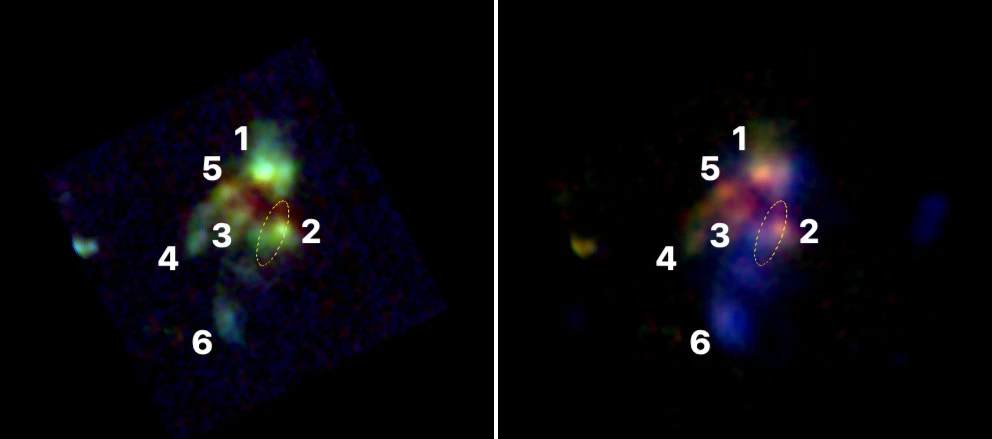
Fig. 4. JWST images of the complex of galaxies associated with the distant radio source TGSS J1530+1049. The image on the left, based on data taken with the NIRCam instrument, shows at least 6 galaxies that are closely packed together. The image on the right, based on data from the NIRCam and NIRSpec instruments, additionally shows large clumps of fast-moving gas (in blue), besides the galaxies. The supermassive black hole responsible for the radio emission is believed to be in the area marked by the ellipse. (Credit: NASA / ESA / CSA / Saxena et al., 2026)
What can we learn from this about the Universe’s past?
Such early radio galaxies are extremely rarely known. Studying them helps answer the question of how the first supermassive black holes grew so rapidly during the early history of the Universe and how they influenced the evolution of the gas and stars in their surroundings. This latest research has uncovered a structure that can be considered the progenitor of the giant elliptical galaxies known in the more nearby Universe, demonstrating how these galaxies may have formed through the mergers of smaller galaxies.
The results of measurements conducted with the JWST and the radio interferometer networks have been published in The Open Journal of Astrophysics and in Astronomy and Astrophysics:
Saxena A. et al. (2026): JWST Observes the Assembly of a Massive Galaxy at z~4. The Open Journal of Astrophysics, Vol. 9,
Link: https://doi.org/10.33232/001c.159461
Gabányi K.É. et al. (2026): High-resolution radio imaging of TGSS J1530+1049, a radio galaxy in a dense environment at z=4. Astronomy and Astrophysics, Vol. 710, A20,
Link: https://doi.org/10.1051/0004-6361/202558162
The research was supported by the HUN-REN and the NKFIH excellence grant TKP2021-NKTA-64.