to review recent results on young stellar outbursts, identify future research directions, and develop strategies for exploiting the scientific opportunities offered by upcoming instruments and sky surveys.
Stars, including our own Sun, form over millions of years from dense clouds of gas and dust in interstellar space. According to our current understanding, star formation is not a smooth and predictable evolutionary process; instead, it can involve highly turbulent and dramatic episodes. Detailed investigations of these events and their underlying physical mechanisms have been an important research topic at the Konkoly Observatory for many years, supported between 2017 and 2023 by the European Research Council (ERC). The international recognition of the Institute’s work in this field is reflected by the fact that some of the world’s leading experts gathered in Budapest between 18 and 22 May 2026. Forty researchers attended the conference in person, while another forty participated online, representing 48 research institutes and universities from 20 countries.
During the eruptive phases, a young star may accrete material from its surrounding disk at rates up to hundred times higher than normal. The energy released by this enhanced accretion causes the system to brighten dramatically, producing an outburst. Conference participants reviewed newly discovered eruptions from recent years, many of which have been monitored with significant contributions from the Piszkéstető Observatory. Experts in numerical modelling presented detailed theoretical approaches aimed at explaining the observed phenomena. Another topic that attracted considerable interest was the impact of these outbursts on the material within the circumstellar disk. The temporarily increased heating can trigger structural, chemical, and mineralogical changes in the disk, potentially altering the environment in which rocky planets similar to Earth form. Such processes may contribute to the remarkable diversity observed among exoplanets, a phenomenon that is widespread but still poorly understood.
Several research projects at Konkoly Observatory focus on eruptive phenomena in young stars. Dr. Zsófia Nagy, the principal organizer of the conference, leads the international GLORIOUS collaboration, which specializes in monitoring the brightness and spectroscopic evolution of newly discovered outbursts, with particular emphasis on systems identified by the Gaia space mission. Dr. Ágnes Kóspál, principal investigator of the previous ERC project, and her group study well-known prototype objects, investigating both the physics of the eruptions and their effects on circumstellar disks. Several university students are currently involved in this research at the Institute, and multiple grants support the ongoing work.
The highly successful conference is expected to become a milestone in the study of young stellar outbursts. Participants agreed that forthcoming sky surveys and observational facilities – including future Gaia data releases and observations from the Vera C. Rubin Observatory – will provide exciting new opportunities. These data may help answer a fundamental question: do all young stars experience turbulent eruptive phases, or are such events characteristic of only a particular pathway of stellar evolution?

Artistic illustration of a young star’s circumstellar disk transitioning from its quiescent state to a phase of enhanced accretion, during which the mass infall rate can increase by up to two orders of magnitude and the system becomes significantly brighter. Credit: T. Pyle (Caltech/IPAC).
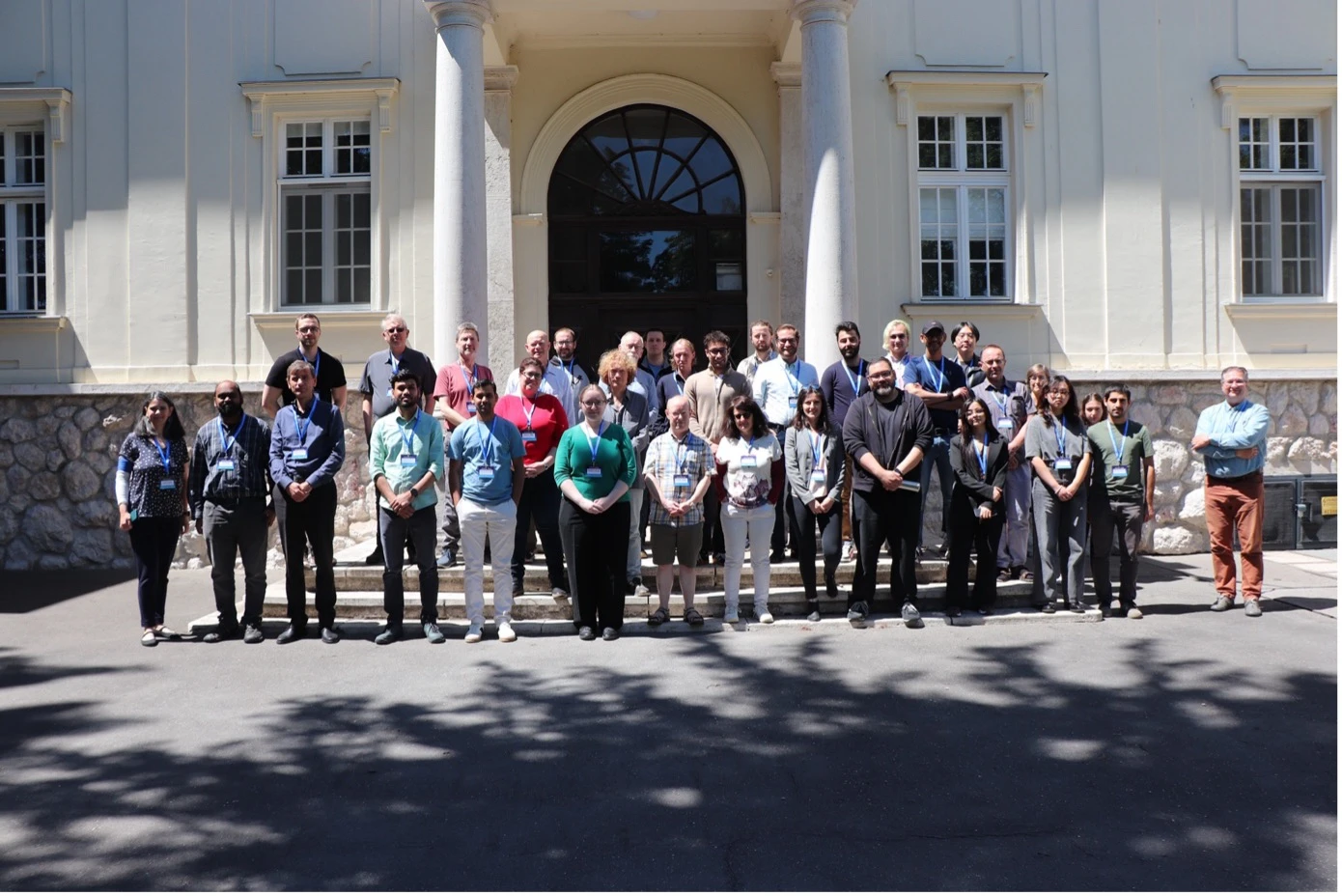
Group photograph of the conference participants attending in person. An additional forty researchers joined the presentations and discussions online.
Additional Information
Conference website:
https://events.konkoly.hu/eruptive_yso_workshop/
Conference posters and recorded presentations:
https://events.konkoly.hu/eruptive_yso_workshop/program.html
Scientific Organizing Committee:
Péter Ábrahám
Carlos Contreras-Pena
Teresa Giannini
Gregory Herczeg
Lynne Hillenbrand
Ágnes Kóspál
Tamara Molyarova
Sebastian Perez
Eduard Vorobyov
Local Organizing Committee:
Péter Ábrahám
Ágnes Kóspál
Foteini Lykou
Zsófia Nagy
Máté Szilágyi
Lis Zwicky
This event was supported by the This work was also supported by ADVANCED 149943 and 2024-1.2.8-TÉT-IPARI-CN-2025-00036 grants, which have been implemented with the support provided by the Ministry of Culture and Innovation of Hungary from the National Research, Development and Innovation Fund, financed under the NKKP ADVANCED and 2024-1.2.8-TÉT-IPARI-CN funding schemes.
.jpg)