An international team of astronomers, led by researchers at the Konkoly Observatory of the HUN-REN Research Centre for Astronomy and Earth Sciences, has announced the discovery of carbon monoxide (CO) gas in five debris disks surrounding young, intermediate-mass stars. Using the powerful ALMA (Atacama Large Millimeter/submillimeter Array) interferometer, the researchers surveyed twelve dust-rich systems to understand the mysterious transition from gas-heavy protoplanetary disks to the dustier “debris” phase that characterizes mature planetary systems.
The study reveals a surprising divide in the gas content of these systems. While two of the discovered disks contain only trace amounts of CO, three are CO-rich, harboring massive amounts of gas, some comparable to the levels seen in much younger protoplanetary disks. The team found that this gas-rich phenomenon is strongly linked to the brightness of the host star; stars with higher luminosity (specifically A-type stars) are significantly more likely to host these massive gas reservoirs.
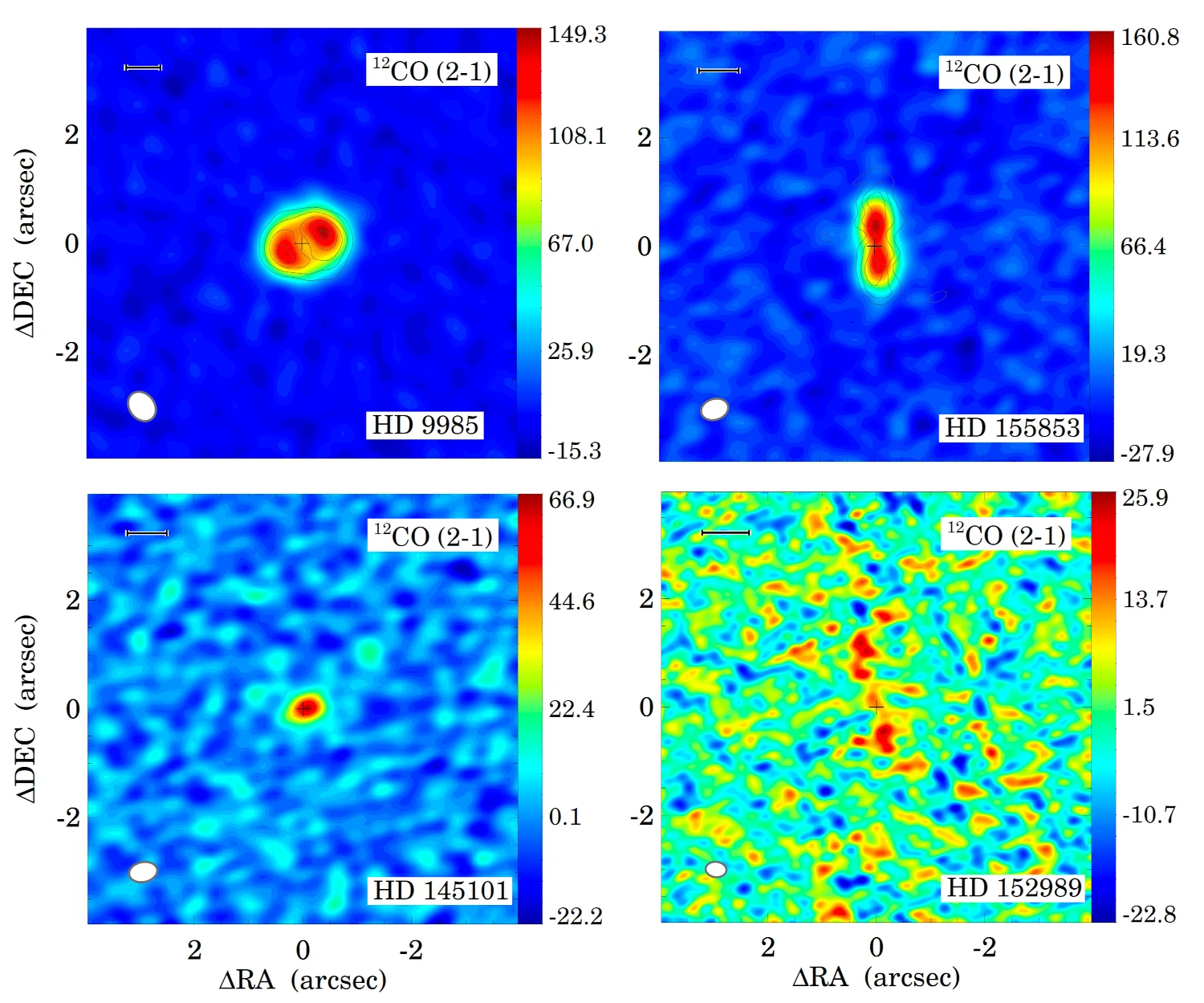
Figure: ALMA images of the brightness distribution of the carbon monoxide gas emission in four of the studied debris disks. Source: Moór et al. (2025, A&A, 703, A15).
One of the most intriguing finds is the disk around HD 152989, which appears to have a “gapped” structure, with gas and dust concentrated in two distinct rings. The researchers suggest that such a structure, along with the asymmetrical gas distributions seen in other targets like HD 170116, may be the “smoking gun” for unseen planets. The gravitational influence of these hidden planets could be stirring up the disk, causing the collisions between icy planetesimals that release the observed CO gas.
The origin of this gas remains a subject of intense scientific debate. In gas-poor disks, the CO is likely secondary, released by collisions between icy comets. However, the massive amounts of gas in CO-rich disks are harder to explain. The team discusses two possibilities: either the gas is shielded from destructive stellar radiation by carbon atoms, or it is primordial gas, leftovers from the star’s birth that have survived for tens of millions of years. These findings provide crucial clues into how planetary atmospheres are formed and how the building blocks of worlds evolve over time.
Project no. 2023-1.2.4-TÉT-2023-00056 has been implemented with the support provided by the Ministry of Culture and Innovation of Hungary from the National Research, Development and Innovation Fund, financed under the 2023-1.2.4-TÉT funding scheme.
Related publication:
Moór et al. (2025), Astronomy & Astrophysics, 703, A15
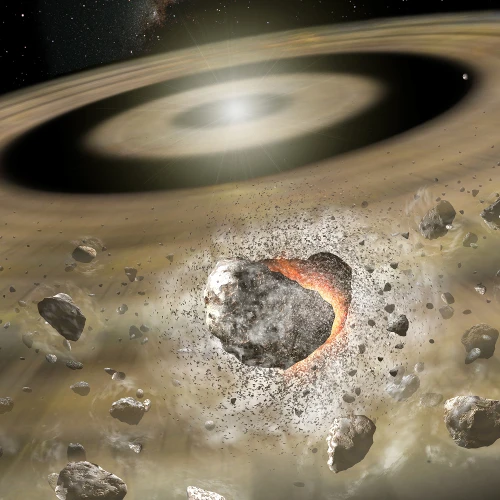
Artist’s impression showing gas generation from the collision between planetesimals in a debris disk. Source: RIKEN.