An international team of Chinese and Hungarian astronomers has unveiled detailed new observations of a protoplanetary disk around the star HD 34282, revealing compelling evidence for dust trapping within a potential vortex, a swirling structure that could be a birthplace for planets. Using the Atacama Large Millimeter/submillimeter Array (ALMA), the team observed the disk at multiple wavelengths, providing an unprecedented view of the dust distribution and properties.
Witnessing the birth of a planet is one of the greatest challenges in modern astrophysics. To peel back these layers, astronomers turned the Atacama Large Millimeter/submillimeter Array (ALMA) toward HD 34282, a young star located 1000 light years away from us. In addition to the spectacular gap-and-ring structure familiar from other iconic disks like HL Tau, the new observations revealed a distinct, bright arc of dust within the disk. Analysis of the data shows that larger dust grains are more concentrated within this arc than smaller ones, a key prediction of models suggesting the presence of a vortex acting as a “dust trap”. This vortex could be concentrating material, creating the conditions necessary for the formation of planetesimals, the building blocks of planets.
“This is a significant step forward in understanding how planets form within these dusty disks,” says Dr. Ágnes Kóspál, co-author of the study. “The size-dependent concentration of dust in the arc strongly supports the idea that we see a vortex, allowing small dust grains to concentrate and grow before they can be lost to the central star, potentially kickstarting the planet formation process.” The team also noted some unexpected features in the images, hinting at complex temperature or optical effects within the disk, which warrant further investigation.
This research highlights the power of ALMA to resolve the intricate details of disks around young stars and unlock the secrets of planet formation. Further observations and modeling will be crucial to confirm the vortex hypothesis and fully understand the dynamics within this fascinating system.
This result is the first joint publication of the Chinese-Hungarian bilateral 2024-1.2.8-TÉT-IPARI-CN-2025-00036 grant, which has been implemented with the support provided by the Ministry of Culture and Innovation of Hungary from the National Research, Development and Innovation Fund, financed under the 2024-1.2.8-TÉT-IPARI-CN funding scheme.
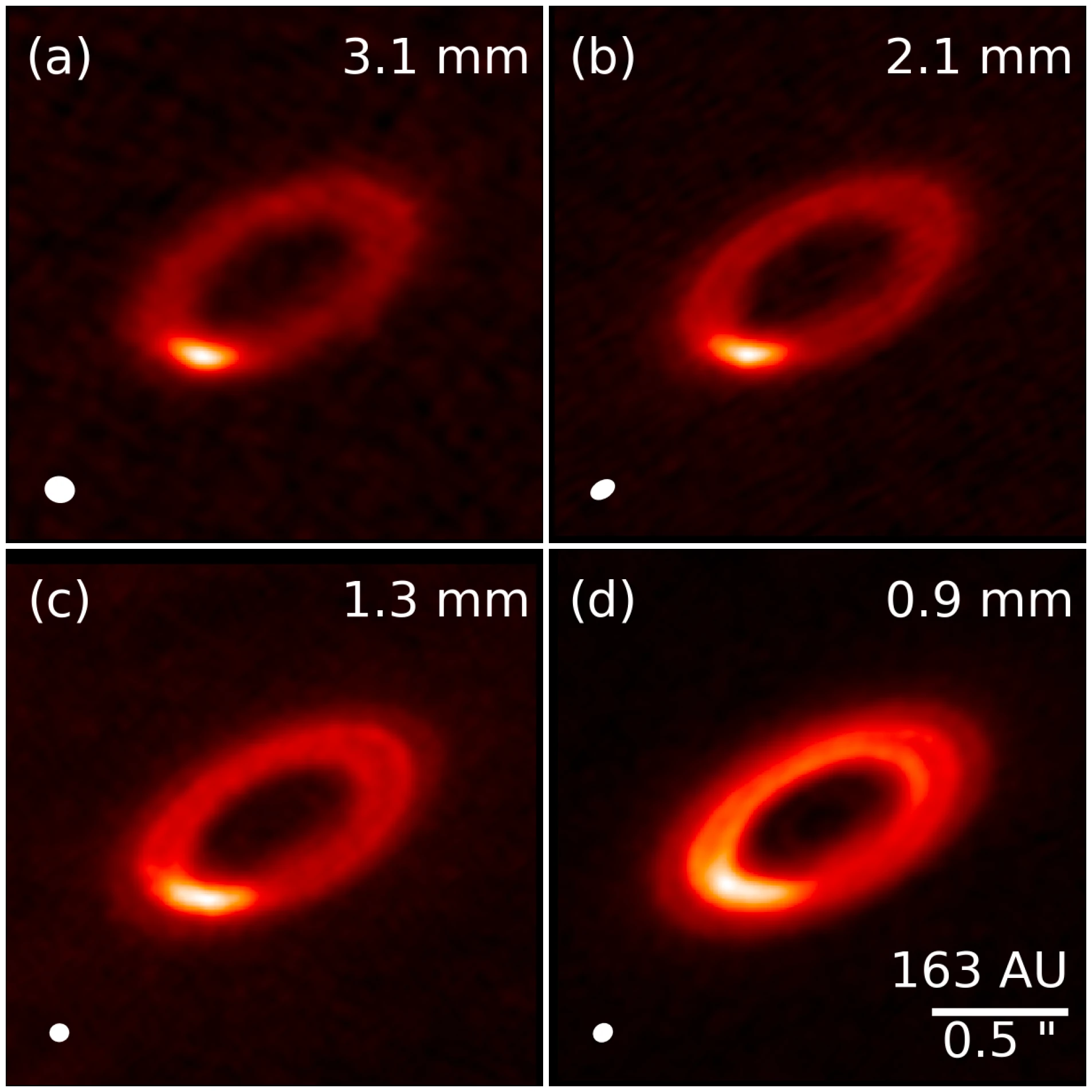
Figure: Distribution of dust emission around the young star HD 34282 at various wavelengths. A bright arc is clearly visible in the disk, which may be a vortex-induced dust trap. The arc is located at 140 astronomical units from the central star, which is 140 times the distance between the Sun and Earth.
Related publication:
Ma et al (2026), Astrophysical Journal, 1001, 1
Contact:
Xiaoyi Ma
Kavli Institute for Astronomy and Astrophysics, Peking University, China
public.btn.email
Ágnes Kóspál
Konkoly Observatory, HUN-REN Research Centre for Astronomy and Earth Sciences, Budapest, Hungary
public.btn.email
.png)