How do we know the structure of the Universe, and how it has evolved over the billions of years since its birth? Astronomers use a variety of methods to investigate its geometric properties. One of the oldest is the so-called angular size–redshift test. The idea is simple: if we can identify objects whose true physical size is approximately known, then by measuring their apparent angular size on the sky, we can infer the expansion history of the Universe.

Illustration of two classical cosmological tests: the apparent brightness–redshift relation (left) and the angular size–redshift relation (right). If we know standard candles with a given intrinsic luminosity or standard rulers with a given physical size, and can measure their distances, we can use them to determine the parameters of our cosmological model. Type Ia supernovae are examples of the former, while radio jets provide an example of the latter. In practice, however, neither class of objects is perfectly standard, making their analysis challenging. (Source: NASA / JPL)
A newly published study has revisited this classical method by examining the radio-emitting jets of quasars – bright, distant galactic cores powered by supermassive black holes. The international research team was led by Mina Ghodsi Yengejeh (Konkoly Observatory, HUN-REN Research Centre for Astronomy and Earth Sciences), a PhD student at the ELTE Eötvös Loránd University.
The objects studied were relativistic jets associated with active galactic nuclei, launched from the immediate vicinity of their central supermassive black holes. The sizes of these extremely compact and powerful radio sources can be measured with milliarcsecond precision using the technique of very long baseline interferometry (VLBI). The researchers analyzed a data set that is more than an order of magnitude larger than that used in similar studies back in the 1990s. This work represents the first comprehensive re-examination of the method in the past quarter of a century.
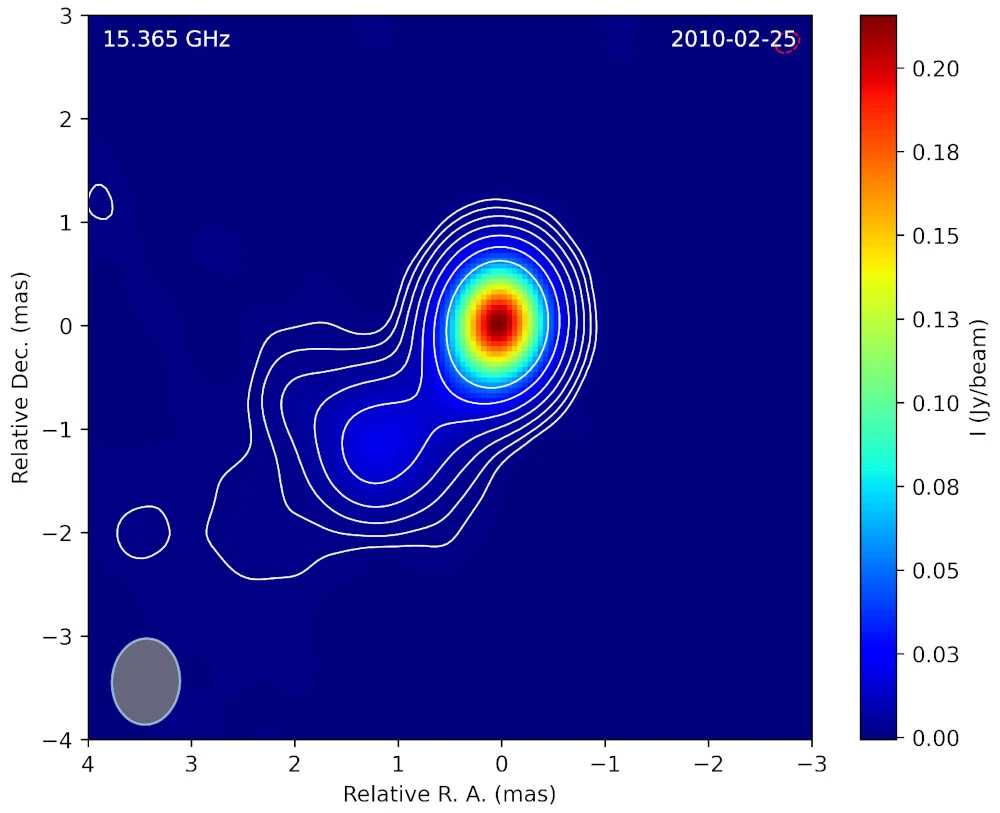
Example VLBI image of a quasar jet (J1426+5406) observed at 15 GHz. The angular extent of the jet can be measured in milliarcseconds (mas). The angular size–redshift study used observations at 8 GHz because this frequency provided the largest data set, containing nearly 5,000 measurements.
(Source: Koller & Frey, 2025)
The results show that the observed angular sizes of quasars are indeed related to their redshifts in the way predicted by cosmological models. The researchers also performed statistical tests by creating one hundred artificial datasets in which the redshifts were randomly shuffled among the objects. These “scrambled” samples no longer exhibited the same correlation, confirming that the relationship found in the real data has a physical origin and is not merely the result of a chance coincidence. In other words, the apparent angular sizes of quasar radio jets genuinely carry cosmological information.
At the same time, the study demonstrates that the method, in its current form, cannot yet provide cosmological constraints on the properties of the Universe as precise as those obtained from other probes, such as Type Ia supernovae or measurements of the cosmic microwave background. The main challenge is that the apparent sizes of quasar jets depend not only on the geometry of the Universe but also on the intrinsic astrophysical properties of the sources themselves. These two effects are partially intertwined, significantly reducing the accuracy of the method. Simulations indicate that the angular size–redshift test could become a competitive cosmological tool if the scatter in the observations were reduced below 20% and if data sets containing tens or even hundreds of thousands of carefully selected objects became available.
Radio astronomy is currently undergoing a revolutionary transformation. New VLBI networks, highly sensitive radio telescopes, and international observatories under construction will map more active galactic nuclei than ever before. The new study demonstrates that the angular size–redshift relation of quasar jets is a real and measurable phenomenon. Although it is not yet the most precise tool in cosmology, it may become an important complementary probe in the future, allowing astronomers to investigate the structure and evolution of the Universe using an independent method.
To facilitate further studies, the researchers have also made the entire data set publicly available.
The study, which combines the analysis of a substantially expanded database with several methodological innovations, was recently published in Astronomy & Astrophysics:
Ghodsi Yengejeh M., Koryukova T.A., Gurvits L.I., Frey S., Pushkarev A.B., Plavin A.V., Kellermann K.I., Kovács, A. (2026): Revisiting the angular size–redshift cosmological test with milliarcsecond radio structures in active galactic nuclei. Astronomy & Astrophysics, Vol. 710, A133
https://doi.org/10.1051/0004-6361/202557047
The research was supported by the EKÖP-24-3-I-ELTE-1026 project, the National Research, Development and Innovation Office of Hungary (NKFIH; grants OTKA K134213, NN147550, TKP2021-NKTA-64), the Momentum (Lendület) Programme of the Hungarian Academy of Sciences, and the European Union's Horizon Europe research and innovation programme (MSCA grant 101130774).