Coronal mass ejections (CMEs) are huge eruptions of plasma from stars and—on the Sun—are the primary drivers of space weather in the Solar System; among other effects, they can produce aurorae that have recently been visible even from mid-latitudes. According to theoretical models, CMEs play a key role in eroding planetary atmospheres, especially for planets that orbit close to their host stars. However, this conclusion has remained debated, as CME detections from stars other than the Sun are extremely rare and typically rely on indirect evidence.
On the Sun, the characteristic radio signature of a fast CME is the so-called Type II radio burst, generated by the shock wave that forms when the CME moves at high speed through the stellar corona into interplanetary space. These Type II bursts serve as important tracers because they confirm that the plasma has physically detached from the star’s magnetosphere.
Using the LOw-Frequency ARray (LOFAR) Two-metre Sky Survey (LoTSS), researchers have detected a stellar radio burst that shows remarkable similarities to a solar Type II event.
The roughly two-minute-long burst, originating from the young M-dwarf StKM1-1262, drifted in frequency from 166 MHz down to 120 MHz. The frequency-, temporal-, and polarization characteristics of the emission all closely resemble those seen in solar Type II bursts.
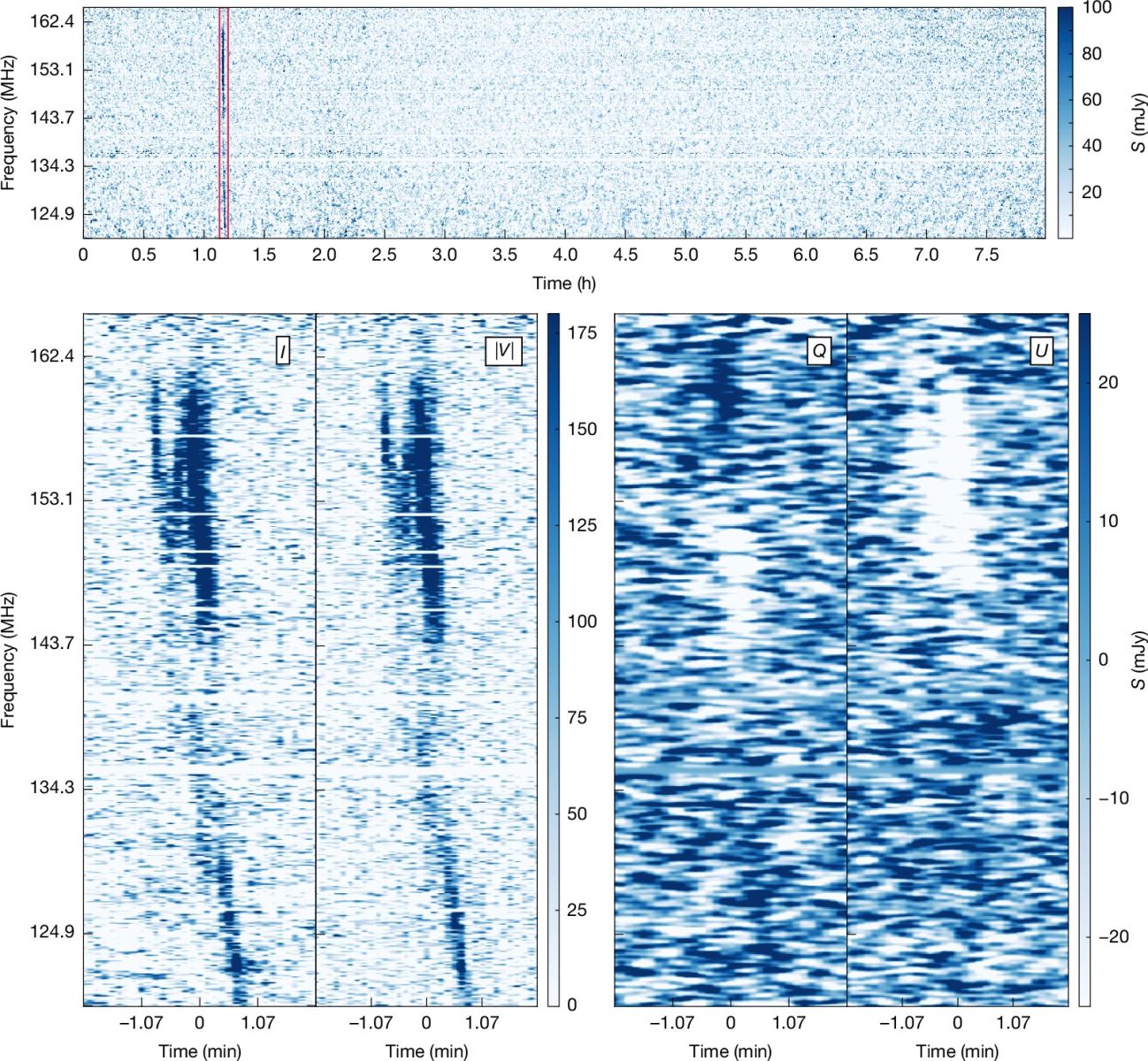
The total intensity dynamic spectrum for the entire 8 h observation is shown in the top panel, with the burst bracketed by two red lines. The burst is centred in the bottom panels, with Stokes I, absolute V, Q and U shown from left to right, respectively. (Credits: Callingham et al., Nature)
From the measurements, the shock speed was estimated to be 2400 ± 600 km/s at 144 MHz. On the Sun, more than ≈95% of CMEs exceeding 2400 km/s are accompanied by a Type II burst. The occurrence rate of such events among M dwarfs is estimated to be 0.84 × 10⁻³ per star per day.
Based on the emission frequency, the density of the ejected plasma exceeds ~3 × 10⁸ cm⁻³, about an order of magnitude higher than what is typically assumed in simulations of CME impacts on exoplanets. This suggests that planets orbiting such stars may be exposed to much stronger plasma environments than previously expected, with major implications for the long-term evolution—or even loss—of their atmospheres.
The research has been published in Nature (https://www.nature.com/articles/s41586-025-09715-3), with related results accepted for publication in Astronomy & Astrophysics (https://arxiv.org/abs/2511.09296, https://arxiv.org/abs/2511.09312v1).